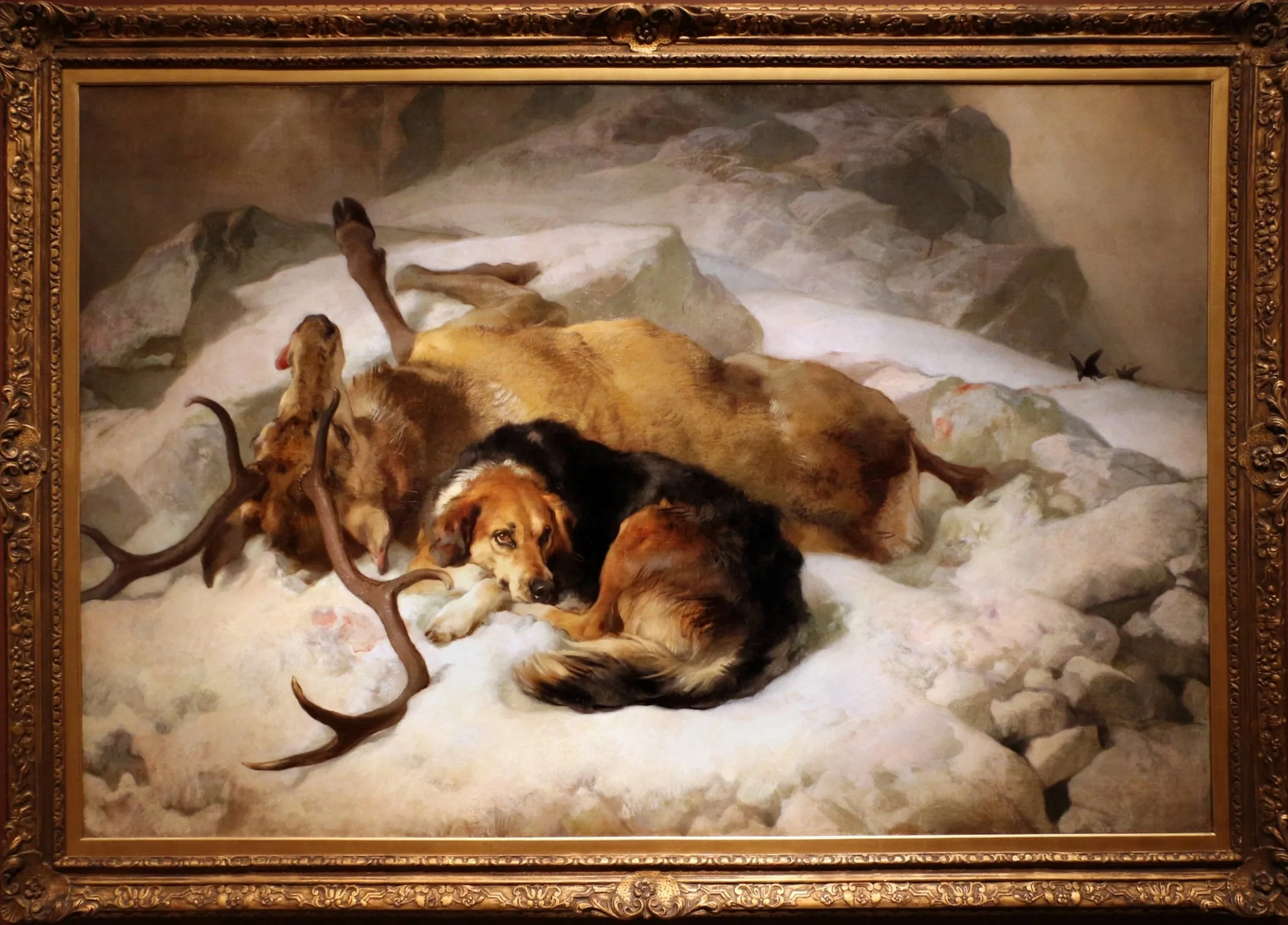
Edwin Henry Landseer’s Chevy (1868)
My Turn
The entire neighborhood is looking down at me, watching me dig a hole in the ravine behind my mother’s house. I am digging a hole because my mother is making me dig a hole. We have a pact. I want to tell these neighbors to go about their business; I want to implement my usual methods. But I know if I do my mother will not be invited back to the summer block party, and I’ve been sort of listening to her lately.
She wants to be one of them. A hobnobber. It must be important.
Once you get past the bulldozer scars of future housing developments and the old horse stables and the guy with the chickens that had them long before anybody else had chickens––maybe since the beginning of time––and the scrappy woods of new growth trees where deer hunters lurk too close to residential property lines, you arrive at my mother’s house. This municipality used to be a hiding place. Now it’s just a place to raise kids if you like spending lots of money. Money is the real problem, as you already know.
My mother communes with the deer. She’s learned their language. She’d rather hunt the hunters.
Secret murmurs curdle at my back. It’s okay; I’m in charge. I have a three-fold plan.
No one is sure why my grandmother’s dying wish was to seal her luggage trunk, the one she immigrated to America with, why she never wanted it to be opened ever again. Why everyone was so afraid of her that they complied with said wishes long after she could do anything about it. We were told we could do what we wanted to the trunk, even destroy it, as long as we didn’t pry the thing open. This is my mother’s mother we’re talking about.
“I thought you had everything handled,” my mother says, somehow right beside me.
“What do you mean? I’m taking control of the situation,” I say, sinking the shovel blade a little deeper into the clay soil, not really making a dent.
“Where is it?”
“Haven’t moved it yet. Thought I’d get things situated first.”
I don’t look up. She knows where the stairs lead. Her mind is going (away), but her mind is (still) going. She is well aware of this situation. She keeps watch. The keys to her apartment in the memory care unit are in my pocket. They jangle when I walk. They won’t let me be.
My mother steers herself down the cellar stairs.
Somebody is being fooled, and that somebody is most likely me. It’s my turn.
She’s managed to drag the trunk up all by herself. It’s just heavy enough to force you into wondering what’s inside. Whatever it is, it’s nothing like a pile of clothes.
We slide it into the earth. I drop my end a little early, but it doesn’t matter; the trunk is unbudgeable.
I sing while I scoop the dirt back over top. I have to give these neighbors something. A little show. But they all scatter. They are underwhelmed. My mother wanders back inside, repeating what she said to me, I thought you had everything handled, but this time to herself or to her unseen business associates hovering in the atmosphere.
Finally. I can retreat to my quarters and read old ship logs in peace.
But then Ace comes over. We met two years ago. I didn’t know he was a good guy right away. The kind who might put my name on his disciplinary ledger if he knew the bloodthirsty suspect that I really am. Let the authorities consult their files. Nothing was ever proven. Anyway, I am prepared.
Since he doesn't know enough about me, he asks me out to a nice dinner against my will. And even though I have a lot of experience with eating food, he orders for me. Everything Ace does helps me decide to keep him in the dark.
“You look pretty, so to speak,” he says, smiling.
I’m wearing a new dress. Hospital gowns are the latest trend. The helpless victim-waif look was already in; it only made sense. It’s the next logical step. Last week, I accidentally wore it to a hospital. My mother had fallen but ended up being okay. Come around here often, one of the doctors asked me, his surgical mask cocked saucily below his neck. An orderly tried to detain me.
I got away.
I always get away.
When you think about it, what’s the difference between royal robes and bathrobes? And acorns dress in fancy berets even though they’re scattered across the ground. So what of it? These are my conclusions, if you care. The purse dangling from my shoulder is completely empty, and Ace doesn’t need to know about that either. Just like Ace doesn't need to know what I keep in my dresser drawer.
Once the food is secured, our conversation leads to the topic of my mother.
“You should try to restore her memory. Remove the dementia. I bet you could do it,” I say.
“I think she’ll be better served over at Gibson Highlands,” Ace says. “I’ve heard great things about their staff.”
“No, this is how it works. You need to heal her. You can work miracles. You’re holding out on me.”
Why say more than that?
Years pass, probably.
We get up from the table at some point, and he deposits me back at my mother’s house so I can be alone with all the garbage. There’s still lots of junk to clean out. My blanket and I both fold over ourselves. But I’m not alone. Not yet.
“I thought you had everything handled,” my mother says, hovering at the doorway.
“Don’t worry. We’ll leave this all behind. We’ll take to the sea at the appointed time. We can be sailors, and we’ll do whatever it is that sailors do.”
“Okay.”
My mother will try anything. It’s her best quality.
Are you staying with me here? Good. Because when I find her in the morning among a herd of deer, pawing at the freshly packed earth in her old bathrobe, she will look as royal as I need her to.
Claire Hopple is the author of six books. Her stories have appeared in Southwest Review, Forever Mag, Wigleaf, Cleveland Review of Books, and others. More at clairehopple.com.