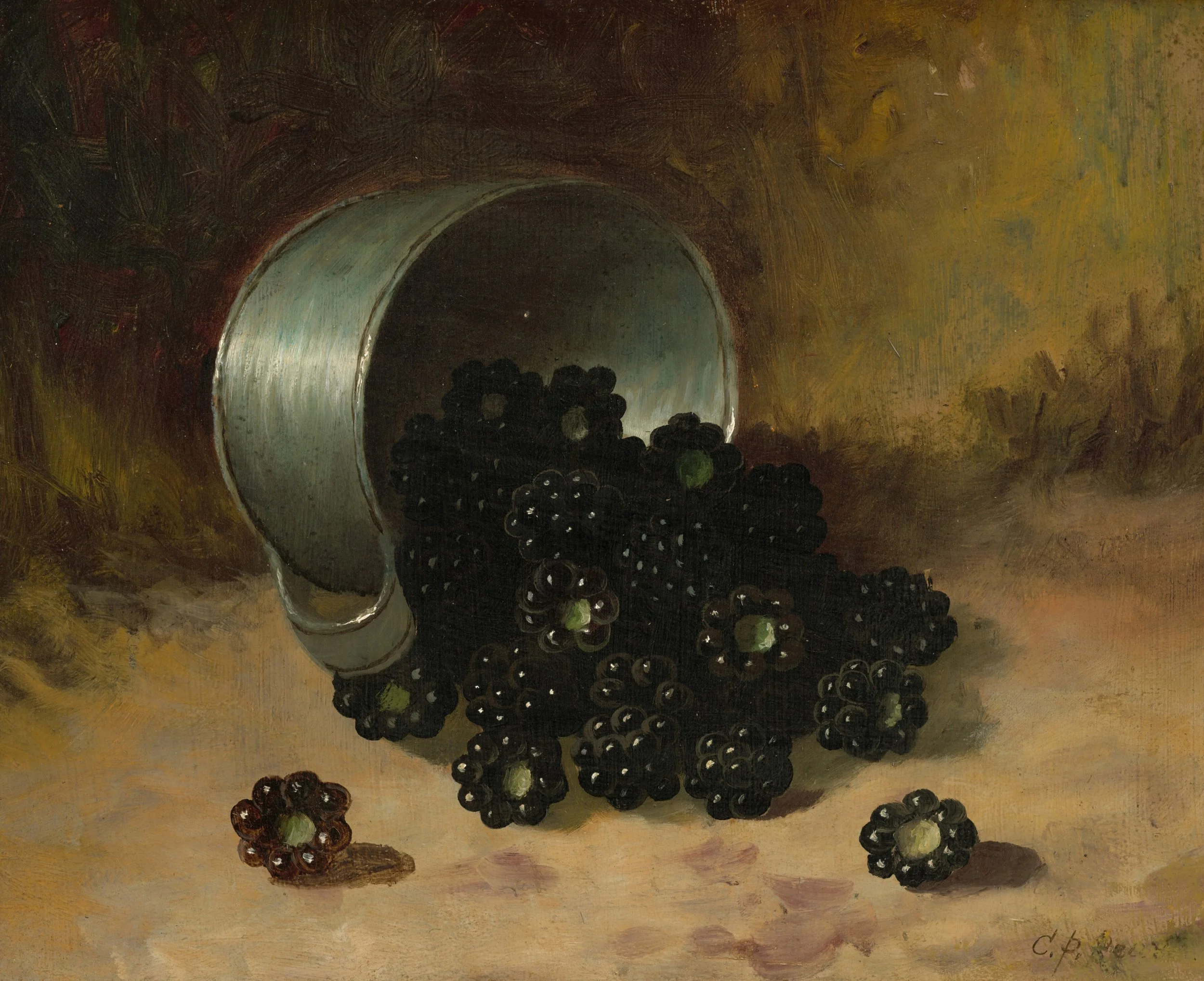
Carducius Plantagenet Ream’s Blackberries Spilling from a Tin Cup (n.d.)
Unmentionables
During the day, they did not learn alone. The lesson concerned coming of age. A man had written a book. Dead now, his name lasted in chalk. To Dr. Literature, adulthood was a destination, not a quiet infection.
The girls put ignorance on their faces, what Dr. Literature desired. If a girl stared too long into a window she could not already be leaving her life. Outside, the baseball field spread toward the woods where deer appeared at dusk to eat trash.
Dr. Literature smiled when he paused, hoping the girls would see themselves in three hundred pages of male suffering. It was a book about transformation. About innocence and ritual. A book a man wrote as a boy.
Dr. Literature interpreted the girls’ exhaustion as mystery. Their silence implied depth, their silence belonged to him.
Then the first girl, Heather, raised her hand to ask whether the protagonist had ever had sex. Erin in the next desk asked if he had ever worked a job, if he only ate snacks.
There was nothing unnice about Dr. Literature’s body. There was nothing lecherous about his posture. The girls could sense the power they had over him. They knew that coming of age was a term to protect men.
They knew every girl preserved something for later. A butterfly in a case. A blade in a fist. At school, they were taught everything that wasn’t.
***
At night, we went together. We stopped at Erin’s empty house for the foil. Her mother was still in the clinic.
We waited by the fire. She emerged with beer and her brother’s tackle box. Her eye-makeup slid off and one of her hoops was out. We were beginning to separate from our faces.
Behind the fence, the horses proceeded through the darkness single file.
She settled into the bench carved with initials. She once drew my face into the wood, the hair cut jagged at my chin. Less bench was blank than covered in initials and insights no longer legible to anyone who wrote them. Wet hands had softened the wood.
Erin stared into the field as though she’d left herself out there. Bras still hung from the clothesline by their straps, disciplined by wind. My mother called them unmentionables when she folded them like curtains. Erin and her brother had peeled the aluminum siding off their house. Green felt showed underneath. I believed I’d been unconscious when she’d called. But the past obeyed revision. And the present.
In the summer, they rented their farmland to the carnival. The workers flirted with us by the Tilt-a-whirl. Their tattoos were fading blue. We stole enough tickets from their zip pouches to buy the cotton candy machine. After were cigarette butts in the dirt, stuffed animals without eyes in the grass.
She watched the eighties in my hand. She kept the foil on her lap. Her brother kept his tools inside the box. The razor. The file. Drugs don’t enter ceremonially. They look like the silverware drawer.
My mother kept her pills beside hotel soaps and cotton balls. Hygiene meant silence.
I swallowed two eighties dry then sucked the paint from another pair. Maritza watched with the concentration of a polite person. She wasn’t.
The tree frogs screamed from the dark like alarms no one answered. The dark was not the absence of anything. The dark was the amphibian.
Erin threw paintball shells into the flames where they burst softly, like corsages catching fire. Pressure was familiar. The metal glowed.
I ground down the pills with my card and tapped them onto the foil. Erin began. Then Maritza.
Then me. The feeling entered instantly. My chest kicked open. The night sky became sequins. The stars looked expensive. A horse lifted a hoof then put it down, carefully, the way a mother shuts down panic in public.
Next, Erin warmed the steel file in the coals, then pushed her sleeve to the elbow. Her forearm was marked with injuries healing in stages. She pressed the hot file over one, into her wrist. Her body rejected. She held it there longer than necessary. Nobody moved. Yellow fluid rose from the burn. Her skin blistered around the edges while the fire snapped wetly.
The smell arrived. Erin always said pain ventilated sorrow. Bodies mistake sorrow for personality. She carved two parallel lines into her wrist. An equality sign. It could’ve been a cross.
She connected the straight lines with a third and lifted the completed H for us to see.
“For Hell,” she said, pleased with the result.
“For Heather,” Martiza corrected but clarified nothing. The night moved back.
Suddenly, names lost utility. I thought of writing mine on a receipt to return to the store. The clerk would read it, and then peer up at me, and say that better words existed. Hunger, for instance, or harmony. Hostage.
“Are you going back to California?” Erin asked me.
The field expected me to stay. I waited for the pills to open.
“Take one off,” I said. My voice sounded far. Girls became women by first lying correctly.
Frogs kept screaming. The horses remained unsatisfied, lifting their hooves in and out of the same dirt.
“When is your flight,” she said. She reheated the tool before passing it to me.
I took it and looked at my wrist. An H was already burned into it. The skin was already correcting the letter.
I threw up bile and spit it like a coin toward my boot. I said, “Take one off.”
***
Later the girls became pharmacy women. Standing in lines for SSRIs, picturing girls at windows, girls staring out at other girls crossing fields at dusk, crossing toward trash left behind by baseball players.
Emily Jace McLaughlin is a writer based in Santa Fe. Her stories and essays have appeared in The Cut, VICE, The Brooklyn Rail, Joyland, Catapult and elsewhere.