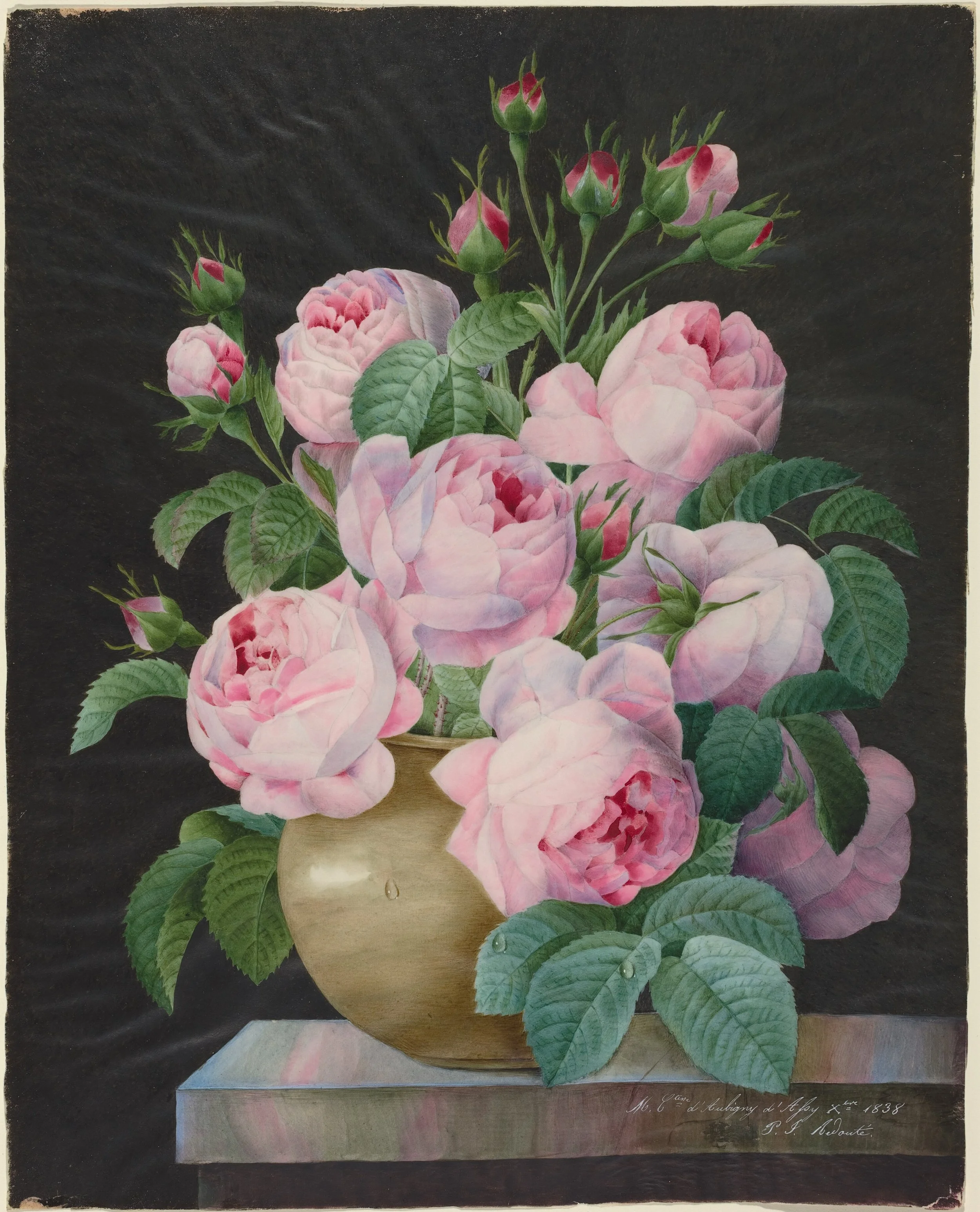
Pierre Joseph Redouté’s Pink Roses in a Vase (1838)
New Recruit
The doctor opened the door with no white coat. The skin on his face looked as if it was losing its will to hold onto his skull.
“So you’re tired?” he said before sitting down, with the tone you might use to ask “so what’s wrong with you, then?”
Jenna reminded herself that she wanted to get better and, therefore, had to be honest with this doctor. That was a first. She’d had a fantasy since childhood of slitting herself open and spilling all over a doctor’s office floor, for a doctor who would look at whatever was surely wrong with her and provide an itemized Action Plan Toward Regaining Perfect Health. But this fantasy died with Georgia. Watching the throngs of sniffling friends throw dirt on her boxed-up, incinerated body drained the last dregs of Jenna’s faith in the healthcare system.
“I think it’s narcolepsy,” she said.
A week ago, she had woken up in a stranger’s yard halfway home from work. She couldn’t remember how she got there, just the feeling of walking into deep water, cold creeping at her shins and bloating the cuffs of her jeans, turning them heavy, pulling her down. She had booked herself an appointment with the urgency one can only feel when they know, at long last, that they aren’t just paranoid, that something is absolutely misfiring in their body’s caverns.
The doctor smiled. He put a stethoscope around his neck and picked up a clipboard she would bet her life he was not going to write on. “You’re interested in a diagnosis?”
“I want to feel better.” She tried to squish her demented desire that the doctor might tell her she was headed for the same final night as Georgia, who was found splayed in the special black silk pajamas that never helped her sleep, eyes stretched wide and magnificent as sickness pushed its way out. Jenna didn’t want to die. But she thought about being found at least once a day.
The doctor stared. “You can sit on the examination table.”
The tissue paper crunched as Jenna sat down. She always felt bad about that. The table was pristine, uncontaminated until she irreparably dented it.
The doctor pressed the stethoscope into her back.
“Your heart is beating rather slowly,” he said. “Does your family have a history of heart attacks?”
“I don’t think so,” Jenna said. She always forgot that doctor’s appointments were also tests of how well you knew your extended family’s ailments.
“Heart murmur?”
She shook her head.
“Heartbreak?”
Was that a standard question? “No,” she lied. “Maybe my sister.”
“Your sister,” the doctor said. “Georgia.”
Jenna jerked away from the stethoscope, still on her back. “Georgia,” she agreed.
“That was my diagnosis.” The doctor looked awfully proud of himself for accurately labeling whatever had killed Jenna’s only sibling. She should have assumed it would be him. Godforsaken small town.
“So you can diagnose me too, then,” Jenna said.
The doctor frowned. “Do you enjoy it?”
“What?”
“The tiredness? Something being wrong?”
“I’m asking you to get rid of it, aren’t I?”
The doctor slid across the room to the printer and handed her a piece of paper, still hot. A long series of words she couldn’t imagine were in English were printed at the top, followed by a list of at least a hundred bullet points, so small she could hardly read them. Sudden onset chronic fatigue. Misinterpretation of or refusal to recognize depressive symptoms. Near the bottom, Complete insomnia, unresponsive to environmental and pharmaceutical treatments, followed by, Potentially fatal.
Below the list of bullet points was an empty signature line.
“I’d like you to consider signing.”
No one had told her you had to sign off on an illness.
“This is what Georgia had?”
“Yes.”
“She signed one of these?”
“Yes.”
Would it still be incurable if she hadn’t signed? Would she still have died, or had she committed to death in advance with a bit of looping ink?
The doctor added, “She was happy to be recruited.”
***
In the parking lot, the wind had picked up. Jenna’s heart beat against the paper, which she’d hidden in her shirt. She would go to work and act as a perfectly normal person would act, and then she would go home and turn on the stove and torch this piece of paper and go on being the healthy sister.
Her phone was ringing for the second time that day.
“Jen, I’m crying,” Georgia said. Her voice sounded especially tinny through the line, like a bad recording of who she had been when she was alive. “But there’s no water left in my body, so it’s like dry-heaving.”
Jenna saw Josie staring at her through her windshield across the parking lot and wished it were someone else driving her home. But if Jenna had wanted to keep her hometown friends she shouldn’t have decided, when she left the Midwest for college, that she was too good for everyone at her high school, even though she was. She had run toward reinvention in LA, peeling her hometown off like a wet T-shirt, and now she had only her sister’s hand-me-down friend and part-time tortured romantic interest. “Why are you crying?”
“I can sleep here,” Georgia said.
Jenna smiled, and the wind stung the corners of her mouth. “That’s good.”
“I don’t like it,” Georgia said. “And I don’t get it. If I didn’t sleep here, what? I’d die?”
“I have to go,” Jenna said, as if she was any more able to hang up than she was to call. “Josie’s waiting for me.”
“Josie? You’re with Josie?”
“Should I tell her you miss her?” Jenna asked. She knew it wouldn’t be true. Jenna’s capacity for ugly, heartbroken feelings was big enough for both of them, but Georgia had floated through relationships on a raft of ambivalence. She’d hook up with her friends at parties in the apartment she’d rented from some rarely-in-the-country painter instead of going to college, but she said she didn’t want to be in love. At first, Jenna avoided these parties, because who wanted to hang out with their weird older sister’s friends? Then she performatively avoided them because Georgia stopped inviting her. Georgia still insisted on telling Jenna every detail when Jenna made the two hour drive to visit, and Jenna asked if each friend was “different,” and Georgia said no. On Jenna’s final visit to the apartment, she got mad that she wasn’t invited to the parties and told Georgia to shut up and stop telling her the details of her sex life. When friends came to read to Georgia and hold her hand while she lay catatonic in her darkened childhood bedroom, unable to sleep, Jenna asked their names and tried to remember who was who.
She remembered Josie. Josie had been blacklisted from the invite list for confusing reasons Georgia wouldn’t elaborate on. But when Georgia moved back home, Josie insisted she was her best friend. Jenna’s mom believed her and Jenna said nothing about it and Josie was there lying next to Georgia, on top of the sheets, every night after work.
“Don’t tell her anything,” Georgia told Jenna. “Tell her I don’t miss her. Tell her the only person I miss is you.”
“When did you learn to do that?” Jenna laughed because Georgia had to be making a joke. She’d said she would miss Jenna in her freshman year, when Georgia insisted on dropping her off outside her dormitory. But that was nearly three years ago. The last time they’d sat on Georgia’s floor together eating mangled omelets, neither knew what to ask the other. Georgia had vetoed talk of Jenna’s sociology thesis, which Jenna believed was out of feelings of inferiority, and Jenna had just vetoed talk of all Georgia’s social engagements out of jealousy. The omelets were half-raw because Georgia had forgotten Jenna was coming. Jenna hadn’t been able to ask what Georgia had been thinking about instead of her because it made her throat clench in a way that made her feel raw as their food.
When Jenna stopped laughing, she thought she heard her sister breathing on the end of the line, but Georgia had hung up. She could never hear Georgia breathe. Such were the ways of the dead.
***
She got into Josie’s passenger seat hurling apologies and didn’t stop until Josie looked at her as if Jenna had thrown up in her lap. She said nothing and jerked the car out of the parking space as Jenna buckled her seatbelt, so the side of Jenna’s head thudded against the dashboard. The sound was a nice contrast to Josie’s clanking bracelets. She looked up, hoping Josie might think this was some sick joke—she wasn’t above laughing at her own pain if it brought them closer together. Josie didn’t seem to have noticed. Nor did she ask Jenna who had just called her on the phone, which left Jenna no opportunity to mysteriously refuse to answer.
“Are you too sick to work?” Josie asked. Jenna felt almost bad for this girl. As if Jenna didn’t know the only reason she’d moved to this town and gotten a job at its only nice restaurant was to be close to Georgia while she died.
“No,” Jenna said. “I’ll help you open.”
Josie shrugged.
Georgia had told Jenna in her early calls not to get a summer job, to live her life, but Jenna had been living enough life in college, where she had a public library bigger than a storage locker and friends who knew CDG and DFW as something other than airports. She felt bad for even thinking the phrase “live her life” around the empty space where Georgia should have been, a space that followed her everywhere, even when she wasn’t on the phone. She liked the restaurant fine, besides. They didn’t give her free food, but she could take as many espresso shots as she liked, and if she drank eleven of them in a row, she wasn’t hungry until the next day anyway. She’d learned to float from table to table on the caffeine high without stumbling or shaking or dropping any plates.
Jenna adjusted Georgia’s scarf around her bicep and flipped out the ends. She had put it on that morning in hopes of endearing herself to Josie. Despite reciprocating Josie’s disdain, she wanted to make Josie confide in her, like her, even love her, the way she had loved Georgia. Josie had been the one to open Georgia’s door that day, the first to scream and stumble back into the hall. Jenna’s fantasy of her own death crumbled when she couldn’t picture who would find her own body, drowned in silk. So she pictured Josie’s scream, Josie’s stumble.
“What, you wear pink now?” Josie asked. “Sick of dressing like a diorama of her last day?” Then she shook her head so quickly it looked more like a spasm, as if she were trying to erase what she’d said from the air between them.
When you learned what hell was, you didn’t have to share it with me, Jenna thought to her sister. A week before she died, Georgia had banished everyone from her room but Jenna, who wouldn’t go near Georgia’s bed and sulked in a corner, refusing to be upset, refusing to believe Georgia’s gaunt face wasn’t a trick of the low lighting, repeating to Georgia until she was nearly screaming that she was going to get better and when she got better they needed to have a proper talk about how Georgia needed to stop faking illness, that it wasn’t even a sensible thing to fake, it wasn’t a real disease, that if you were desperately tired all the time, you could sleep. That just made sense. And if, on the off chance this insomnia was real, maybe Georgia could finally teach Jenna, who fell asleep like a little baby every night and woke up feeling like a failure.
Never again, she swore to herself now, would she accept special treatment from someone even potentially on the brink of death. When they die, you’re left with just the ghost of that specialness and the resentment from everyone else who loved them and wasn’t given the same attention.
“We can’t all dress like it’s Valentine’s Day at the trinket store,” Jenna said. There was only so much indignity she could swallow.
Josie slammed the brake to make a left, and Jenna felt every vertebra in her neck crack. “You know the reason I can’t look at you is because I’m sick of you, right?” Josie said. “I’m not scared of some college kid. I’m sick of watching you slouch around all summer in your mourning clothes as if you even miss her.”
“Just because I’m not a high school dropout doesn’t make me a kid,” Jenna said, aware this should not have been the accusation that most offended her.
“You can’t even drive yourself to your own doctor’s appointment,” Josie said. “What were you even in for? You’ve never been sick. She said that all the time. You’ve been perfectly fine at every doctor’s appointment since you were a kid.”
That wasn’t fair. Georgia’s endless starry-eyed friends called her honest, some patron saint of confessional illness. Is that where over-sharing got you? They’d been in doctor’s offices together as kids when their mom didn’t have time to take you both in for separate appointments to have them tell me I wasn’t feeding you enough avocados. Some kids are just off-putting. They’re fucking expensive. Georgia would stare up at the doctors with her giant, puddly eyes and tell them that she cried uncontrollably at the end of the ABC song because “they just wanted someone to sing with them and no one would,” and that she was afraid she would never be able to have children—“I’ll just bleed them all out.” And Jenna would sit in her chair in the corner, waiting her turn, scowling and gritting her teeth and contracting her stomach so all her own hypochondria hardened into a rock that she couldn’t cough up if she shoved all her fingers down her throat at once. Maybe she was doing it wrong. Georgia refused to give Jenna tips since she caught her puking after her thirteenth birthday dinner.
“I might have what she had,” Jenna said.
Josie slammed the brake into the floor again. Jenna braced her wrists against the dash to spare herself a concussion. They played an unbearably tense game of synchronized, unbroken staring ahead for the last mile to the restaurant.
Josie turned off the engine.
Without ungluing her gaze from the windshield, she reached over and squeezed Jenna’s hand. One of her bracelets pressed into Jenna’s palm, cold.
“Don’t say anything else about her—or whatever illness you think you have—to me again,” Josie said. “Confide in someone who didn’t just lose their—” She shook her head. Jenna was hoping to learn what Josie had thought she was to Georgia, but apparently she didn’t know either.
Then she dropped Jenna’s hand and was out of the car so fast Jenna almost thought she’d grabbed it by accident. She let her heart explode in victory anyway. When she stepped on the pavement, her legs gave out. Sunlight quivered around her.
She was supposed to move into her new campus apartment in a week.
The first time Georgia had called was a month after she died. Jenna had been in Georgia’s room bagging up her clothes. She answered the phone with “Thank god.”
Then she heard Georgia’s voice, hollow and whispery.
“I had to talk to you. Will you talk to me?”
Jenna’s relief splintered. She had closed her eyes and pretended Georgia was still lying in her bed, knife of sunlight splitting the dark curtains behind her.
From the ground by Josie’s car, now, she tried to keep her eyes open. She could stay there, work in the restaurant, apron strings imprinting her waist, high on caffeine, while the leaves dried and curled and she left dishes in the sink until her mom remembered she was there, stay until winter, when Georgia’s bones would freeze to the marrow and she would stop calling. She would shove Georgia’s specter inside herself, turn it right side out, absence into presence, remove any necessary parts of herself to give it space.
When she moved her arms, she was swimming. Energy drained upward, syringed out of her.
Something is wrong. It was a comforting thought in its certainty.
The ground held her.
She pulled the paper out of her shirt, dug her fingers into the earth, toward her sister, pulled them up and smeared dirt on the signature line. She swore her palm was still cold from Josie’s bracelet.
A fingernail worked to sign her name in the dirt.
Erin Evans is a writer from Michigan, now living in Brooklyn. Her work has appeared in BOMB, The Creative Independent, Spike, Full Stop, Zona Motel, GUM, and Vestoj.