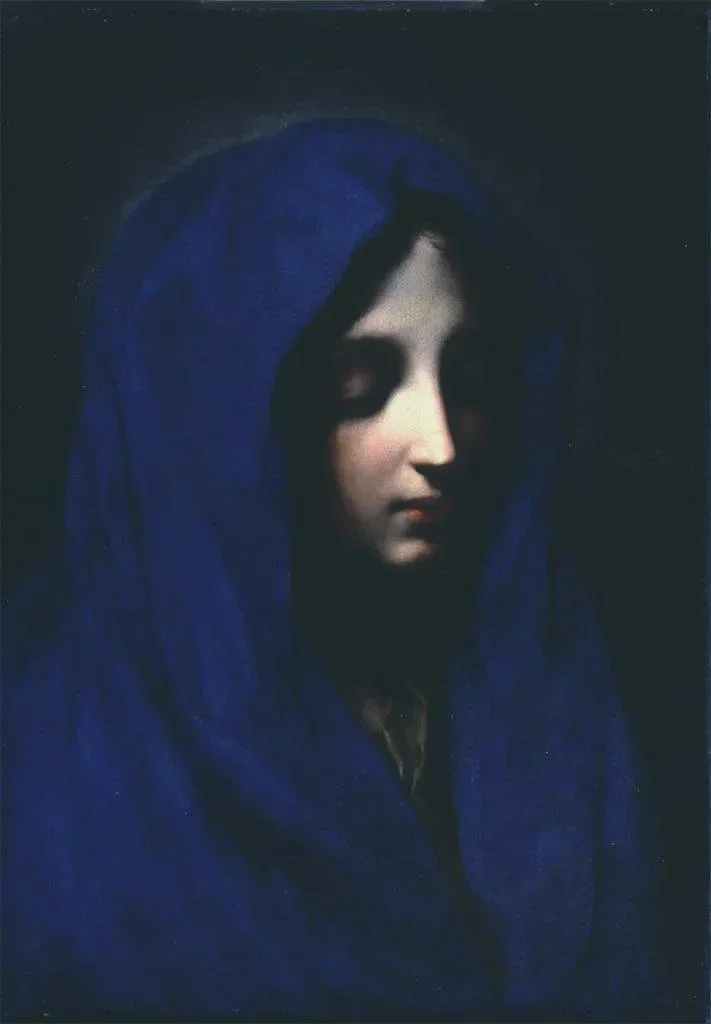
Carlo Dolci’s The Blue Madonna (c. 17th century)
The Woman Who Was a Pain in the Neck
One day they came, because the farmers were blocking the highways. They had been told to stop here, in my neck of the woods, and on the day they arrived, something crept from my spine to my neck. For days I walked around with my neck very stiff, unable to move, unable to look side to side, unable to check, unable to know what was happening. The truckers were everywhere. Their vehicles were larger than anything in our landscape, which is vast, windy, and arid, and which rarely speaks anything. It just sits and storms inward, or rings clear as the truth, or is something, but not this, not this, I told the woman at the bar, who stared at me and said, well, for me, it’s quite good, you see, it’s good for my business.
What do you think Joan? And she turned to a man in the corner, who was old, and who always sat there, and who drank, always drunk, and who stared at my back, only this time, I could not turn my head to check that in fact he was looking. So, uncomfortably, I looked straight at the woman, and I said, yes you’re right, yes that’s fine, just the bill. Just the bill, please. She was trying to fill up my glass. And it’s true that in those days I had started to drink, drink excessively, yes, drink more than I wanted, and I could not really tell if it was because of the truckers, or if I was trying to numb the great pain in my neck, which, as I told you, could now only look forward. It was hard to look forward.
Here, I am known as the girl who looks over her shoulder. At all times I am carving the spaces or beside or behind me. I am the girl who can tell you which of the men is now looking, and where, and which women are chatting, and just the thing they are saying, and which old person is dying, with no signal, in some corner, in silence. And Joan was just one of those spiders. Yes, a man, but a man who was dying, and there was really a difference. In the time of the truckers, I could only walk home if I was incredibly drunk. With my stiff neck, if I was horribly sober, I trusted nothing around me. But still, deep down, I think I wanted to see one. I always thought I would catch them as they crawled from the bathroom. On all fours, I imagined them. I imagined the way they would hold me, though I doubt they would hold me, they would hurt me, said my neck as it stiffened.
And it was a tiring thing when my neck began all its rambling. But it did, and did often. My neck was the most talkative thing on my body. A complainer, a sad son of a bitch, it went on and went on. It had to hold my head, which was so heavy with nonsense, and it had to shelter my throat, which was a scared little valley, and it had to look around, without fail, for the good and the bad, keep an eye out forever. What a chatty thing it had become. Since the day I was born, it had twitched with each possible danger, it had arched with the cries of my pleasure, it had peered down the void of my navel. In those days, this was its favorite pastime. But the abyss won’t talk back, not the way that my neck did. My navel was smug with a primal time it wished to share with no other part of me.
On that night, in its curious new state, of being stiff, of being still, looking forward, my neck said we should veer from our path. Not go home, but walk on. And in the time of the truckers. Let’s take those feet we call ours, those two bright useless slabs, and those legs, nice and long, and that bottom, which the people admire, and that back, and that bust, and that head, and get walking. It was stiff, the stiffest it had ever been. But it spoke and spoke freely. It was night, or not quite, yes, the sun was just setting, and I followed it. I had a bad habit of following its every move. With the years I had noticed, how it bent just a little bit forward, how it cursed every star, how most often, it would only look down or look sideways, at the men, at my navel, at the earth, as if planning my burial. And here we were now, on the side of the road, and I thought, what a fool, and that really, what woman had ever found happiness on a road in the dark. And in the time of the truckers. But my neck, now not able to check if a person was following us, ordered strictly: keep walking.
After passing a field of red flowers, we arrived at our dark destination. It was a restaurant, and its lot filled with trucks. And though the sun had just set, the restaurant was brimming with truckers. And the truckers were good for their business. I stopped at the window and watched how the men shoveled ham from their hands to their mouths to their stomachs. And my belly now grumbled, but my neck pressed us on. Now we headed in the other direction, where their monsters lay sleeping. The lot had no lights but the adjacent road had a flickering streetlamp, so that, intermittently, the monsters were revealed. There was one truck, however, which shone of its own. At the helm, on its forehead, rose a blue neon cross. My neck, which rarely looked up, felt intrigued by the blueness. And despite the pain that the movement provoked, it now said we should go and investigate.
Investigate what? I wanted to ask, but we were already climbing the steps of the truck in question, and soon our whole being was soft with the sheen of that blue. We were wet, we were wet with it, like a body in the grips of a sea. For the light of the cross was so warm, so inviting. It made you want to spread out and be naked. Or at least that is now what my neck said. What do you think? it asked, and this time, it spoke to my hand, which made an immediate move for the handle, and before I could stop them, we ducked into the truck. Who knows why the trucker had forgotten to lock it. Inside, my eyes ingested an altar. That is the first thing we noticed. There was a woman, completely nude, cloaked in blue. This was the Virgin. Then another, a mother, or some woman much older, and a daughter, or some woman much younger, and they smiled with the curve one had gifted the other. My legs squatted as I sat in the seat of the trucker. And the strangest thing happened, I put my hand on the clutch and imagined the thrill of so sordid a monster. And my back was now arched and my neck now relaxed, for the first time in weeks. What blue power!
Do you think there are women who do this? asked my lips, which was odd, for my lips were unusually quiet. But no part of my body responded. And instead, my neck hushed, my legs buckled, as I glimpsed a man’s shadow come forth. The blue trucker was heading home. He was stout, with sharp whiskers, and a rough head of hair—and all blue, and all blue. He had eaten too much. You could tell by the pace of his walk. He was tired. Now he wanted to glimpse the old face, now he wanted to glimpse the young face, then the face of the Virgin, before drifting to sleep. But here I was, in his seat, without asking, and my breasts now perked up, as if saying, that if only he notices, we will get what we want.
But my neck started twittering, and despite all the pain, it kept doing so, and my throat, quite at odds with my neck, had now started to salivate, but the slime irked my lips, which kept mum, as my eyes now had started to whisper. For this is how they communicated. But the rest of my body would have nothing to do with them. With my neck, my eyes were often at fault for the bad things that happened to us.
The man arrived at the top of the steps. He must have thought he was having a vision. We decided not to speak, no, not one of us. We stayed quiet. And he looked at us, at first scared, then intrigued, and then slowly, a hunger, and this look we knew well. My neck twitched, but now things were in motion, and my breasts got their way, and down there, where the language was other, something squirmed, both with fear and excitement. We did not speak his tongue. He put one hand in his pocket and for a moment my hand imagined a knife. And my arm, which spoke its truth very rarely, now decided to say: If he enters, we must come to embrace him. So he entered. And we came to embrace him.
On that night, when he left for the restaurant, he had not imagined returning to a blue apparition, and something about us scared him, but with that fear came an age-old desire. And my neck was at fault. We all knew it. But from the depths of my loins, not one bit was complaining, as the trucker knew just what he was doing. Perhaps the altar had been built for exactly this prayer, for the blue apparition, yes, to pray for that cavern, now to open and open, the way all of me did, without knowing for sure, or being able to know, what on earth was now happening, and my neck, still so tight, now went calm with the blue, as the trucker was nibbling its edges. And its edges were soft. It was something I knew. It was something they told us. And the trucker now said it, of course, but his language was new and opaque, and I could make out no word, only rhythm. But when he spoke, my tongue curled into his, and I tried to retain all its movements, and I thought—and this was me, not my neck, not my hand, not my arm, not my feet, nor my breasts—that perhaps in our spit was our language.
And I was overcome by the greatest desire to gargle his spit, to let it seep down my throat—but my throat did not share my same wish—and my eyes, which had closed, and had ceased all their whispering, had now opened, and I noticed the trucker was looking. He could just not believe it. That after years of these roads, from one country to the depths of another, from the east to the west, and through all kinds of weather, his blue virgin now opened before him. And he drowned there inside her. And he drowned there inside me. And that spit was so sweet, and his language, which I wanted to say, but my neck had said otherwise, was perhaps, was perhaps, yes, Hungarian, now had seeped into me and my tongue was in heaven, though my throat was rejecting it. And his hands were around me, and they held me so close, and he slipped now inside of me, and I knew we were one. We were one. He was one with his Virgin and I was one with all parts of me. What blue power! I hushed.
And as he spoke to my neck—for the truth was my neck had been always the one, the one anyone spoke to in those intimate moments—and that’s why both my hands, caught in longing and jealousy, would obsessively stroke it, as my nails scraped the words which were gifted me—but we should stop all our thinking! We should stop all our thinking! For I will miss that strange moment. And I have, I have missed it. Like most times, I was elsewhere. It was over just the way it began, like a dream. And my neck now reacted, with the instinct to leave, for it had wanted the act, but not the thing that comes after, and though my arms tried to hold the embrace, both my feet and my legs were now following my neck. But the trucker insisted. Or at least I imagined he did. He insisted more violently. You cannot have the Virgin just once. Once you taste that blue paradise, you can never go home. To the old, to the young, to your country. You must bury yourself in her blueness. Once you’ve tasted the Virgin, all the trucking and traveling, all the restaurants, ham, make no sense to your body. Only her. Only you. Only blue. But of course, the whole thing, the whole thing, was a misunderstanding. And my neck, which had started to panic, now returned to its stiffness, and my lips, which his teeth had assaulted, now refused the advances, as the trucker insisted, insisted.
So we tore the door open and I let out a scream and as soon as I had, the blue trucker came to. It was awful. Much like waking a boy from his childhood. In an instant, he was old and was wrinkled, and his mother was nowhere, and his father was absent, and the house where he slept was no longer. And as I came down the stairs, the blue slipped off my skin, and the trucker stared strangely, with the eyes of a man in a nightmare. And I ran with my body through darkness, through the field of red flowers, extinguished.
And I thought, and I thought, this is why I can’t listen: to that neck, to those legs, to those arms, to those teeth, to those lips, to those feet, to those breasts, to those regions I was told not to mention. And whose language I don’t even know. This is why I must listen to no one. This is why I must never leave home. And I passed by the bar, and my dress was on backwards, and Joan, who was there and still drinking, and now smoking a cigarette, made a move for my neck, but my neck, which had tired of men, which had tired of drunkenness, pained its way to the left and I shouted: Won’t you leave me alone! I am not, I was never a virgin! And Joan only laughed, only laughed like a man did, yes, with all of his body, for his body was whole and cohesive, and I felt, did not give him the troubles that mine did.
Olivia Baes is French-American multidisciplinary artist living between Paris and Catalonia, where she runs the artistic residency La Rectoria. She has translated works by Marguerite Duras and Charles-Ferdinand Ramuz into English, including The Easy Life (Bloomsbury, 2022), Six Films (Inpatient Press, 2025), and Into the Sun (New Directions, 2025). As curator of the James Baes Foundation, she is re-contextualizing her late father’s archive of erotic, fashion, and lifestyle photography spanning the 1960s to the 1990s. She is currently completing a book of fables entitled The Women, of which “The Woman Who Was a Pain in the Neck” forms a part. In November 2026, she will be a Visiting Artist at the American Academy in Rome, where she will work on The Beholder, a hybrid memoir drawn from her father’s photographic archive and her own collage work. Her artist’s film Diary of the Earth (Anna Sanders Films) will be presented as part of the group exhibition The Fire Between Us at this year's' edition of LOOP Barcelona. Her debut feature film, Je suis fleur (Buffalo Films, Nightjar Films), is forthcoming in 2027.