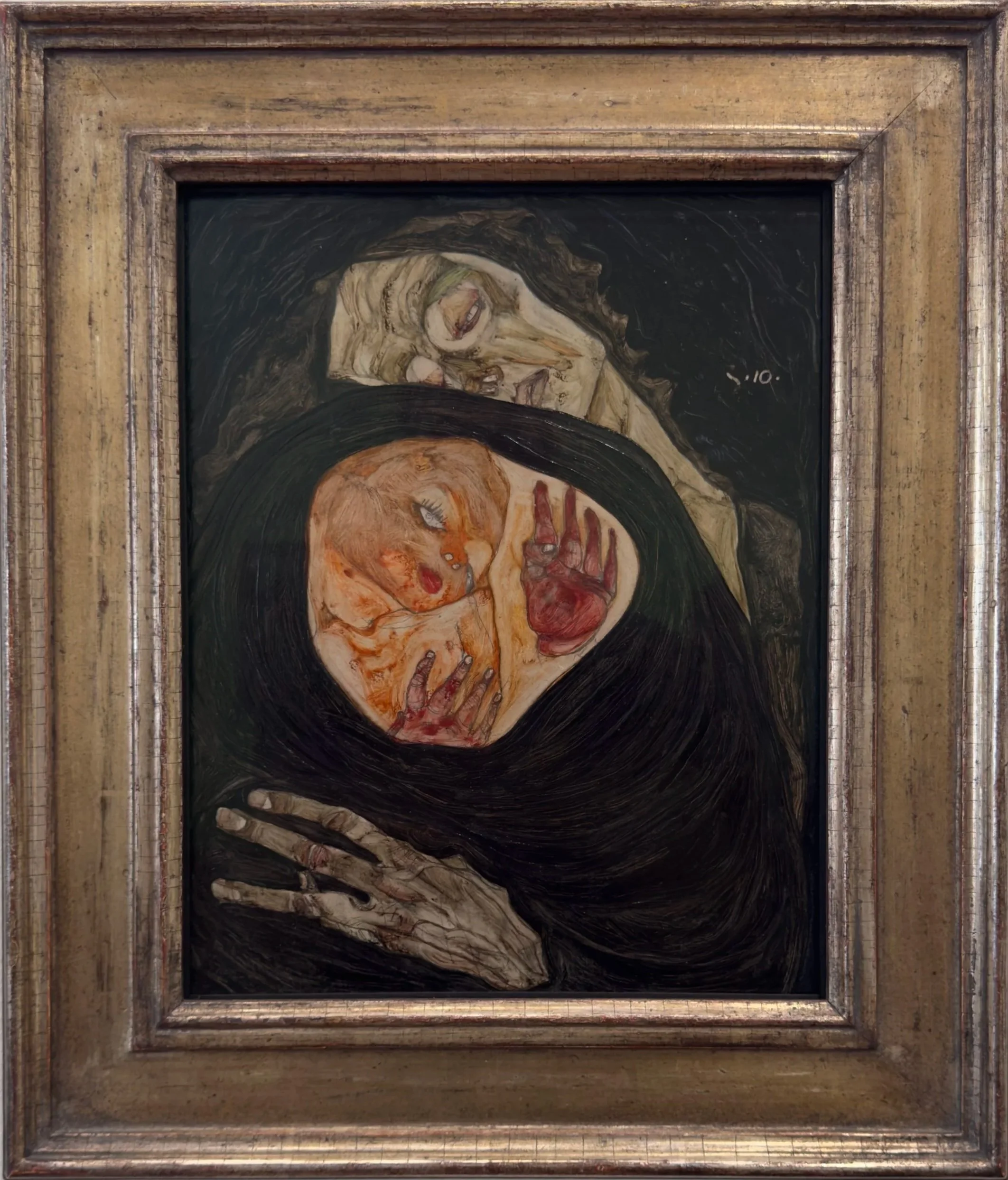
Egon Schiele’s Tote Mutter I (1910)
Why I Watch
Of all the ways in which self-knowledge may be fostered, perhaps one of the greatest is a person’s ability to discern how they view the past, at every time of life and every age.
I started watching reality TV the last two weeks of spring semester my Freshman year of college, after taking drugs which kept me awake for days. The drugs didn’t make me jittery or agitated. I was simply just awake.
After the fourth day, I started feeling weird. To mimic the mental relief of sleep, I started watching Keeping Up with the Kardashians for eight hour stretches at a time. I had never seen the show, but the women were so womanly it lulled my brain to rest. I watched the first four seasons in a week.
Kris Jenner reminded me of my mom with her lesbian haircut, refusal to rest, need to be right, sustained emotional agony, and public denigration of Caitlyn. She let herself be pushed around by her kids, but only for show. Kris was always in charge and two steps ahead.
My mom would have hated this comparison. She hated stay-at-home moms and moms who bragged about their kids. She looked down on women who got work done on their faces and hadn’t gone to college. She spoke seven languages, slept four hours a night, cooked five-course French meals once a week, and got into politics by interviewing the Providence Mafia about their ties to local government. She was ugly in that precise feminine way which turns heads.
The Kardashians explained my family to me. I spent hours binging them, studying my disappointment and academic and emotional failure in comparison to their daily lives full of sunshine and wealth. I understood the rhythms of their family with help from the repeated arc-narrative of each episode. Issue, secondary issue, then resolve.
My dad and I had been fighting, and I was angry at myself. The sisters fight, fake fight, fight to take care of each other, and fight to make each other better. My dad and I weren’t fighting like the Kardashians. Like the always-secondary Kardashian men, his internal logic was a mystery. I felt abandoned by my dad but seen by Kris Jenner.
In college, I may have been smart, but I was a bad student. I didn’t like my face, I doubted my thoughts, I felt like a perpetual outsider, I felt at once too old and too young. My Junior year I took a class with a professor who gave me zeroes on all my essays. She was brutal and horrifying, brilliant and diligent, and told me that if I kept writing her shit essays, she would take it personally.
In response, I decided to quit drinking, sex, and drugs for the remainder of the semester in order to pass the class. As a result of my newfound vigor, I received a check mark, then two check marks, then, strangely, twelve check marks, a plus sign, a question mark, and “See me after class.”
This professor wanted to know why I only wrote about mothers. “Because mine died,” I told her. She teared up and hugged me, told me that she also suffered with her mother, who hadn’t died but was also gone, emotionally.
This was 2016. Trump had just won, and this professor was a Black Marxist-Leninist who refused to vote and watched all major media stations religiously in order to learn about the continued myth-making practices of the United States.
We were crying softly, commiserating about our mothers. I had found a connection with this woman, my guilt trip, my guilty pleasure, talking about our mothers.
“Donald Trump explained my mother to me,” she said. Not because her mother was a Trump supporter or politically-aligned or anything like that. This professor had been watching Trump on TV, that endless coverage on CNN, Fox, and NBC, and had suddenly understood. Trump’s manipulation techniques, enemy mongering, public cruelty toward naysayers, fear of failure, and emotional performance crystallized, for her, the root cause of her Mother.
The unbearable part of memory: My mom died when I was seventeen after a ten-year bout of pancreatic cancer. That’s an extraordinary time to survive with that type of cancer. She got sick when I was seven, eighteen months after 9/11. It was from the carcinogenic dust in our apartment, even though we threw everything away and couldn’t go home for five months, just like the Red Cross told us. We lived across the street from the towers, in the Frozen Zone, on Broadway between John Street and Maiden Lane, close enough that my dad saw the first plane go into the towers from our balcony, and my mom and I saw the second one from my schoolyard, where she had just dropped me off. PS 234, the red brick school with wrought iron boats carved into its gates.
Like sexual desire, memory never stops. It pairs the dead with the living, real with imaginary beings, dreams with history. I was seventeen when she died, so her death signified or, at the very least, aligned with the end of my childhood. I lived a full life with her, and then my second one started. For a while, I felt as if my life had ended. I had died with her and was now living in a ghost-image of myself. Though I got As, went to parties, got into college, had friends, etc., I felt a total unraveling.
There’s a familiarity in the third person. I remember myself in the context of others. I grew up looking in at the lives of women like the Housewives, and playing with someone like Kelly Cutrone’s daughter. I know exactly where Kelly is when she takes a walk around Tribeca with her daughter in the first season of Kell on Earth. They run into a woman who owns the dog they gave up for adoption. I realize I know that woman: she’s the wife of my one-boobed high school art teacher who told me someone, someday, would find my eczema sexy.
This is the Tribeca I remember, the one I can still smell, the one I grew up around. It’s hard to go back and see Emily Ratajkowski, for example, posing for pictures at Edward’s, because that type of obvious beauty never used to exist there. When I watch The Real Housewives of New York City, I’m swept into their sidewalks, their brownstones. I’m not there, but my vision and my desire to transport myself back into their lives takes over the scenes. I can feel myself there. I’ve walked down those streets, I’ve made out on that corner, I’ve felt that desire, I’ve climbed those townhouse stairs and been taken aback by the immense, carpeted wealth. I’ve had sex in a room like that. I recognize every inch of the screen. I remember sushi and chocolate milk from Bazzini. I remember getting chased by the BMCC guy on meth who went by “The Pterodactyl Man.” I remember when the Whole Foods on Greenwich was a Gamestop.
I remember the Twin Towers, and I remember the decade of rubble. I remember 9/11, my fourth day of Kindergarten. When I returned home after my Freshman year of college, the Freedom Tower was finally erected. I remember the obvious metaphor of a hole in the ground becoming a hole in my heart.
Of course people die and things change. The Real Housewives of New York City failed once it invited a younger New York generation, one who embodied the empty success of post-9/11, post-Sandy New York. Sonja Morgan may live in unruly decadence, but Kristen Taekman’s Battery Park apartment is stylistically cruel.
Even Leah McSweeney lives in a horrifying Wall Street building. I grew up four blocks north of it. My brother’s friend lived there. I know it well. Anonymous, fluorescent, and uninhabitable. Few people lived in the Financial District until after 9/11, when the Downtown Alliance began its revitalization campaigns, and the bankers became convinced it was safer to walk to work. Now there are bars and restaurants and malls. I remember when Broadway cleared out after 6pm. I remember the dingy returns section in the basement of Century 21, getting a cheap blowout at Olga’s Salon and Spa, walking a mile to Pathmark to grocery shop before Jubilee or even Zeytuna existed.
Of course people die and things change. What’s rare is that my mom did both the dying and the change. The president of the Downtown Alliance, the non-profit which manages Lower Manhattan’s Business Improvement District, she was the reason for the Fulton Center, the Oculus, the tear downs, the new storefronts. She controlled the economic development, public safety, and transportation systems of Downtown New York.
I blame her for losing Century 21, hiking prices at Sam’s Falafel, and making it impossible to walk around without bumping into tourists only there to witness a false memory of American destruction.
Still, there’s a park dedicated to her memory, between what used to be China Chalet and the Battery Parking Garage. Elizabeth H. Berger Plaza. Last time I went I brought flowers and cried, surrounded by addicts nodding off and a homeless person taking a shit.
Of course people die and things change. Of course all places have a history, most likely one of gentrification and new glass buildings which anonymize and brutalize the neighborhood. After college, I lived in Brooklyn and then Queens, strategically displacing others to make room for my fantasy of return. My anger at the concordant effects of money, death, and time isn’t individual to me.
The memory was everywhere, though. I saw her in the sidewalk cracks, through steaks of grime, and in every oil-sloshed puddle. I walked around dazed, seeing double. Every block looked like what it used to be, overlayed with what it had become.
I needed to think clearly. Maybe physical distance would allow me to let go, to see better. I packed a duffel bag and moved to Chicago.
Then one night, I couldn’t sleep. I wasn’t jittery or agitated. I was simply just awake. I stared at the ceiling, practiced meditative breaths, put on a sweatshirt, then took off all my clothes. The night turned into a week, and I started feeling weird. Something about the Chicago air, the silence in the night, the newness of every corner, every block. I had moved because I’d had too many memories on every corner. I moved because I live in my head, and it’s an open head, something unhealed and bitter. I moved for relief, but now I couldn’t sleep. I reached for my computer, and started watching.
All italics from The Years by Annie Ernaux.
Phoebe Kaufman is a Chicago-based writer and editor. Her essays can be found in Forever Magazine and anthologized in Blake Butler and Ken Baumann’s You May Now Fail to Destroy Me (forthcoming 2026) and Kardashians: A Critical Anthology (Routledge 2024). Her poetry has been featured in Forever Magazine and on Pitymilk Press’s Instagram and the Poetry Project’s website.