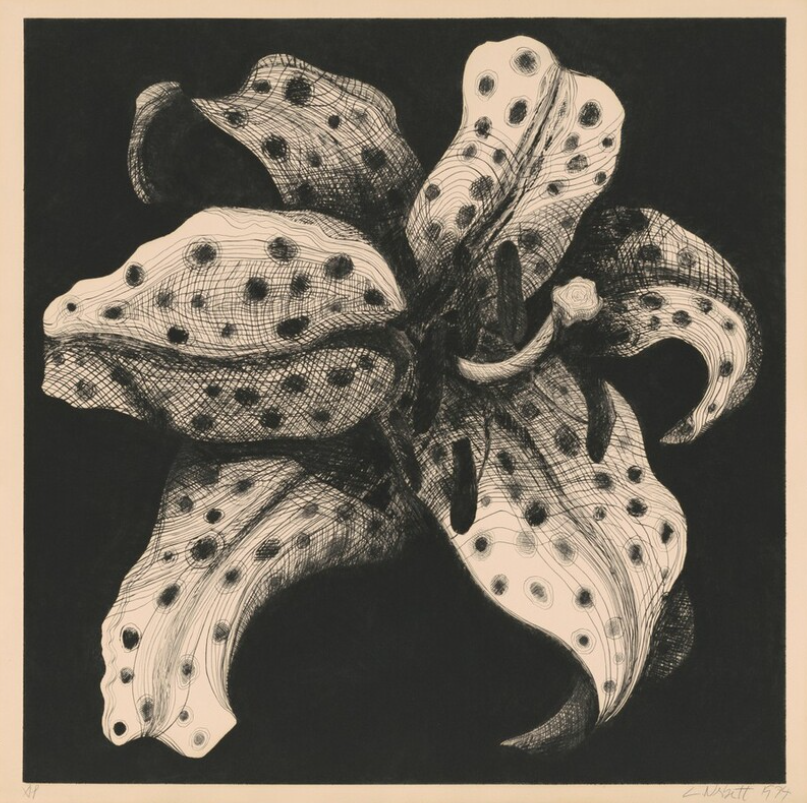
Lowell Nesbitt’s Flower (1974)
Demonlover
It’s not a death sentence, anymore, but it is permanent. A permanent fact arrived and brought with it an unrelenting sorrow. I had to lie down in the dark. My cat was in pain, and I couldn’t help him. This pained me. I had tried to stop fetishizing my own pain. The young poet read their spare lyrics in an anemic conference room in the desert. It was hideous, the forms that constructed us, the forms that gave, allegedly, to one’s life, a sense of meaning. This was the trouble I was always with a bitter tongue circling. I thought the problem with another poet was probably money, that they had it. I had on my shelf a small vial of perfume said to smell like money, which is mainly paper and metal and fiction. Like if you didn’t have to worry about money you could, it was true, worry about other things, a bronze skirt. To live a life preoccupied with words and their meanings, the wrecked consequences of their misuse. I tell everyone to vote for something, voting feeling sickly. The city hands out money to those who need it, if you submit the correct forms, a debasement. A woman whose wife died left her a house, on a street named for a dry creek. I can’t help her. There is paperwork involved. Real property. The law which doesn’t do anything on its own. It must be used, as a weapon. Language, here, I mean, with true consequence. I did love the gesture of a woman declaring herself a literary figure, among men, a writer of life, including details about children, the tedium of artichokes. I considered I wanted to write about the city, a great poem for the city of Philadelphia, what this would of me require. One has to find in one’s life a sense of estrangement from one’s life, to write about it. The poet declaiming her first book’s uselessness, and why. Another poet I suspected was rich, knew was, and knew thus I could only so much care. This made me feel awful, aging with this anger, like a vicious dog in my heart. I just thought it was stupid, to worry, when you had money. I need to go to the woods with my friends, said a rich woman who was once cruel to my friend. To have, like that, a desire called a need. At a party, I speak to a woman I met in a sterile municipal building. Here she wears a collar made of zippers. What would life conscript me to, hurtling ahead. I read the poem about the filmmaker who raped his assistant, which I wrote before I knew what he did. Before bed, I read the Wikipedia page about Roman Polanski’s rape trial, which is separate from the page about him, the man. I become so angry I consider abandoning the prospect of art. What is the power you have over others, the conversation club asks. I answer a phone. The phone makes a living. Porn is depicted in the film with blurred pixels that do little to obscure the mechanism. A red dildo, with veins, enters, gently, a woman’s mouth. At a certain point, verisimilitude falls away. A gloved hand enters a mouth, and this is or isn’t pornographic. The pornographic is conflated with the violent, both offering thrill mainly by what is meant not to be seen. On Grindr, ads for games where you are a girl collecting eggs from chickens play in between dick pics, required viewing. It was confusing to be perceived as whatever I wanted, it seemed, or open to any kind of lover. I can’t tell if it’s what I want, or if what I want is so linked to my own debasement. When I felt I was in love, I was being flayed. Now a dark river underscored an ordinary day. I crouched on the ground outside a federal building to listen to women, mostly, on my phone, tell awful stories into a camera. We’re glad you are here, a woman says, dutifully, after each one. This did give a sense of relief, like if I could keep the brutal facts from staying buried I could prevent some evil flower from taking root. And yet it was mythic, this dimension of life, the idea that one could with thoroughness and vigor cleanse oneself of what some other age would call sins. It was a way to make a living, to wade into a river and let leeches attach to your thighs, to be later removed and sold. It was a living, to let a box of lice feed at your ankles, harvesting blood to be used to make vaccines. I dreamed several fingers on both my hands had been mangled, bleeding, and on the way downstairs in the morning find real blood on my thumbnail. I couldn’t apply the bandages in such a way that they would stick. I had rid my life of too many things and now missed a pink shirt I had once owned and could never retrieve. I felt money debriding every surface. It had a brutal, liquid contour. I did hate the woman, trimming her roses. We did, in a seminar, discuss the class signifiers in the text. A law student emailed the famous poet, just to ask her a question, and she did reply. My teacher and I did have a falling out over the value of reading or not reading Robert Lowell. She had, like many, sort of lost her mind after the election. A film could make you feel bad in a way that made you feel less insane for feeling so bad. This was the promise of art. Someone I used to love never understood me because of our different viewpoints on art. To me, it was sort of the only real thing in the world. To them, it was a thing that fit into the larger picture of one’s life, and thus could be valued for its resonance with one’s personality, or mood. Aesthetic signifiers, I thought, observing a stranger with a New Yorker tote. To have lived one’s whole life mainly in books, which I wanted, but couldn’t have, and so said I didn’t want, and so said was a waste of human life. A video of a vintage doll factory, plastic heads extruded from metal molds. It surprised me, the grainy texture of the film, remembering for how long plastic has been accumulating on earth. What troubled me was the suggestion that violence and horror were new, technologic, but I didn’t know exactly where they had existed prior. Whether there was a new extremity blooming or an old extremity acquiring new forms. And why, anyway, did it have to be one or the other, as I spoke it. Could not a thing be both old and new.
Temperate
Thinking about rent, thinking about loneliness
Thinking about embossed cow on mug, my untrimmed nails
There was a line against suffering I had forgotten
Lost motivation, sense of life clapping its hands
Sense of life with its rich, abundant greeneries
How could I get it back, feeling of unbridled feeling, feeling of true living
Incense mixed with strawberry vape smoke in a dingy room
It felt categorically untrue, the kind of lit-up pathways
Down one hallway my life, burning, and another, burning with beatific grace
Had lost track of my gender, what I wanted versus what just happened
No one wanted my lecture on film but I did not apologize
My appealing qualities cooled to a waxy pool, dead light
The cat ripped the head off a rat and left its intestines spilled on the stoop
Auguries, signs, prophecies, Abigail writing about praying, earnestly
A religious texture had overtaken even the grayest song
Like there was meaning, separate, out there, whether I tended it or not
Like horrible things were happening inside me, unbeknownst to me
Was this being a man, had I become a man, interior
Knowing that the source of my suffering was an action I undertook daily
I felt bad and refused to do what would make me feel better, like a mathematical proof
The novel’s sex scenes began to bore me, their repetitions
Sex felt good, this was obvious, and expressed emotional and psychological currents
Life on a dimming planet, a cliche that supported dimness
Could sense a wildness I once confused with virtue was just youth
I could try and annihilate time through facts of living
A nightmare with the exact rhythm of a TV show
Was I thrilled, to find my interior life so thrilling
Were there real people on the other side of their images
A decision, which had a final quality, a coat of lacquer
Like a knife ripping flesh from core, or bone
To have accompanied a beautiful afternoon, even in absence
To gladly consider each unbent patch of grass
To imagine a life laundered fresh with lilacs
To, across vast stretches of time and space, retain a sweet scent
Perhaps there was beauty in the pockmarked nature of time erasing
The present half-dead already, dipped in memory
A threadbare suit of light, a shame that groaned
Having written against shame, it still burned
I had at the core a gruesome plant I could neither kill nor tend
This was what made film so astonishing, its backlit honesty
No longer believing in narrative, only blackened symbols
Why I don’t respond to a text from someone I love, I don’t know
Why, preferring my own dreamy solitude, I lie down silent
We had been given a solemn fate, mine a calculated logic
What, after all, was so bad, except for the loneliness
It wasn’t hurting anyone, a crab raking its claws on sand
Having let another summer dissipate, unswimming
That was where I went now, in my heart
An oceanic leap, the hem of the shoreline pulled back
Next time I swam, I’d be an apology
The life of one’s mind a rope pulled through a net
An actual sorrow, at having made one’s choices
Like for a while I had a life and then it bound off into snow
The spiritual quality of once turning inward
A mirror revolving at the center of a lighthouse, casting light out
I preferred to feel things, but this was not a system for living
Everywhere, once you can see it, allusions to shared belief
Having desired specificity, I once again rambled like a philosopher
The film star aping the famous musician with horrible tenor
The dead poet’s presence having shaped another’s tongue
I made my choice, what I wanted, and then resented it
In rooms illuminated with purple, technologic glow
Once, I had been able to offer a charming malleability
Now a golden hand revolves at the center, stacked with fruits I cannot touch
Having been cursed with solitude, the violent loneliness of a cloud
I hated the reductive nature of categorizations
Introduced at a party as a triple Scorpio, which I’m not
Had exchanged an excruciating presence for bearable mornings
Having traded Dawn in a black leather vest for foamed milk
Having opened my heart to a bigger landscape, green with calm
There were only so many claustrophobic rooms left to sweat in
Like applause at the end of a movie, while stringed instruments carol
Like the woman wanted to fuck her husband, this the best we could do
In the morning, the rat’s gnawed skull has shrunken
Each residue fades, an inevitable conclusion
What was there to remember, or to forget, really
Lacking a sense of conclusion, or purpose, I could walk into the ocean
I pick up a stranger who lives on Pearl Street, next to a little park
It was in fact the absence of God that began to repel me
Like if one could consider oneself normal, it would get simpler
Who, after all, was making anyone do any of this
Feeling the obvious, familial origin, a fucked narrative
They’re not always bad, the philosopher claims, carefully, the doors trauma opens
Each arched portal evokes, without meaning to, an orifice
Like yes, there were entryways, but they led nowhere
Steph Cawley is a poet in Philadelphia. They are the author of No More Flowers (Birds, LLC) and My Heart But Not My Heart (Slope Editions).